Best Time to See Bears in Yellowstone
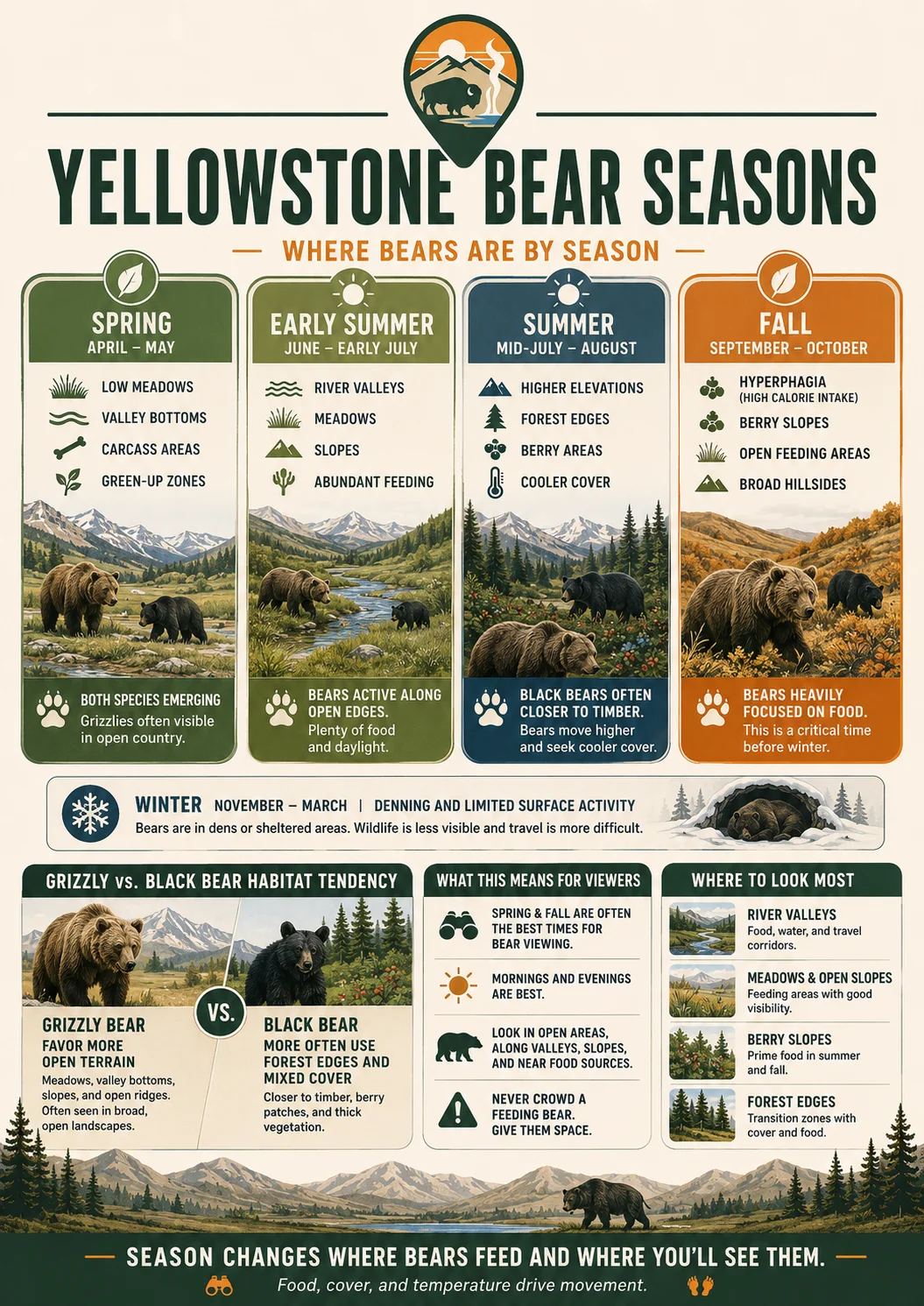
Bears in Yellowstone run on a clock set by food and snow: emerge in spring, gorge in fall, sleep through winter. Match their calendar and your chances of a sighting go up sharply.
The two best windows
Spring emergence (late April–June)
As snow melts off the lower valleys, bears descend to dig for roots and hunt winter-killed animals. NPS first-sighting data shows grizzlies appearing as early as March 10:
| Year | First grizzly | Where |
|---|---|---|
| 2018 | March 10 | LeHardy Rapids |
| 2019 | March 8 | Mud Volcano |
Spring bears forage in the open meadows of Lamar and Hayden valleys, making this the most reliable viewing season.
Fall hyperphagia (September–October)
In hyperphagia, bears feed almost constantly to build winter fat. They’re active for long stretches across meadows and streams, which improves viewing — though you must keep extra distance from a food-focused bear.
How snowfall sets the schedule
Bear emergence tracks the receding snowline. The more snow, the later the green-up that draws bears down into the valleys. Here’s average monthly snowfall — note how it lingers into spring:
Official bear activity comparison
NPS annual totals provide context for how roadside bear activity changed between the two parsed report years. These are park-wide aggregates, not viewing targets.
⚠️Never feed or approach a bear
By month: a quick guide
- March–April: first grizzlies emerge; snow limits access.
- May–June: peak spring viewing; cubs appear.
- July–August: bears move high and into cover; harder to see.
- September–October: hyperphagia; long active hours.
- November: bears den up; viewing essentially over.
Once you know whento go, the sighting comes down to method — dawn timing, open ground, and glassing. That’s the field craft in how to see a bear in Yellowstone.
Frequently asked questions
What is the best time of year to see bears in Yellowstone?+
Two windows. Spring (late April through June) when bears emerge from dens and forage in lower, visible meadows. And fall (September and October) during hyperphagia, when bears gorge on nuts and carrion before denning and are active for long hours. Summer viewing is possible but harder as bears move to higher, brushier ground.
When do grizzly bears come out of hibernation in Yellowstone?+
Grizzlies begin emerging in early spring. In 2018 the first confirmed grizzly sighting was on March 10 at LeHardy Rapids; the first grizzly with cubs was seen on April 28. Males emerge first, followed by females without cubs, and finally females with new cubs.
When do bears go back into hibernation?+
Bears den up in late fall. The last confirmed grizzly sighting in 2018 was on December 18; the last black bear was seen on December 20. By November most bears are denned, though a few may be active into December in warm years.
What is hyperphagia and why does it matter for viewing?+
Hyperphagia is the intense feeding period in late summer and fall when bears consume up to 20,000 calories a day preparing for winter. Because they're actively feeding for many hours, they're more visible — but also more focused and protective of food sources, so keep extra distance and always carry bear spray.
Is fall bear viewing safe?+
It can be, with precautions. Hyperphagic bears are food-focused and can be less tolerant of approach. Stay at least 100 yards away, never get between a bear and a food source or escape route, make noise on trails, and keep bear spray accessible. Do not stop in the road or create a wildlife jam.
Sources & data notes
- Emergence and denning dates: NPS Bear Management annual reports (2018, 2019).
- Weather: NOAA NCEI GHCN-Daily, Mammoth station.
- Hyperphagia and denning biology: NPS and IGBST grizzly ecology references.
- NPS Yellowstone Bear Management annual reports — National Park Service (Only a small subset of available annual bear reports is currently parsed.)
- NPS Yellowstone bear management page — National Park Service (Official bear-management process and BMA context; annual reports still need deeper PDF parsing.)
- NPS Yellowstone grizzly bear facts — National Park Service (Official grizzly facts from Yellowstone Science; species context only.)
- NPS Yellowstone Bear Management Area map links — National Park Service (Bear Management Area image-map links extracted from the NPS bear page; closure/safety context only.)
- NPS Yellowstone Bear Management Plan — National Park Service (Official management plan for bear-human conflict reduction and visitor safety; not sighting data.)
- NPS Bear Management Records archive finding aid — National Park Service (Archive finding aid for bear sightings, incidents, IGBST, and management records; not parsed as observations.)
- NPS first grizzly bear sighting of 2026 — National Park Service (Current official seasonal emergence signal; single event context, not a public viewing point.)
- NPS 2026 grizzly bear capture operations notice — National Park Service (Official seasonal capture-operation safety notice; closure/safety context only.)
- USGS occupied range of the Yellowstone grizzly bear 2008-2022 — U.S. Geological Survey (Range boundary derived from telemetry plus verified observations/sign; not individual locations.)
- USGS IGBST Yellowstone Grizzly Bear Investigations 2024 annual report — U.S. Geological Survey (Greater Yellowstone Ecosystem grizzly report; not limited to Yellowstone National Park.)