Yellowstone Grizzly Bear
The grizzly is Yellowstone's apex omnivore and one of its two bear species. Once reduced to a remnant, the Greater Yellowstone population has recovered to hundreds of animals — and spring meadow viewing is now extraordinary.
Overview
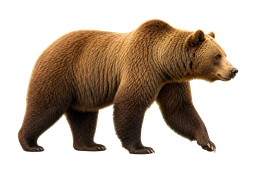
Grizzly bears (Ursus arctos horribilis) are large, long-snouted brown bears with a distinctive shoulder hump built for digging. They're omnivores whose diet shifts with the seasons — roots and rodents in spring, berries and moths in summer, nuts and carrion in fall.
The Greater Yellowstone Ecosystem grizzly population was listed as threatened in 1975 and has since recovered; NPS and USGS monitoring put the GYE population around 700+ bears. They're most visible in spring (foraging in lower meadows after emergence) and fall (hyperphagia, the feeding frenzy before denning).
Where to find them
- Lamar Valley: Spring meadows — grizzlies dig for roots and hunt winter-killed elk.
- Hayden Valley: River meadows and carrion; strong in spring and fall.
- Mount Washburn & Dunravan Pass: Summer grizzlies follow the green-up upslope.
- Antelope Creek: A classic summer slope-viewing area (closed to off-trail).
When to look
Two windows: spring (late April–June) as bears emerge and forage openly, and fall (September–October) during hyperphagia when they feed almost constantly. Dawn and dusk are best.
- How to see a bear in Yellowstone — the seven-step field method
- Where to see bears in Yellowstone — area-by-area habitat guide
⚠️Stay at least 100 yd away
Frequently asked questions
How can I tell a grizzly from a black bear?+
Look for the grizzly's prominent shoulder hump (a muscle mass for digging), dished/convex face, and large rounded ears set wide apart. Black bears have a straighter facial profile, no shoulder hump, and taller pointed ears. Color is unreliable — black bears can be brown or blonde.
When do grizzlies come out in Yellowstone?+
Grizzlies emerge from dens in early spring. The first confirmed 2018 sighting was March 10 at LeHardy Rapids. Males emerge first, then females without cubs, and finally females with new cubs in April–May.
What is hyperphagia?+
The intense feeding period (late summer–fall) when bears consume up to 20,000 calories a day preparing for winter. They're more visible because they feed for many hours, but also more focused and protective of food sources — keep extra distance.
Are grizzly bears endangered?+
The Greater Yellowstone population was listed as threatened under the ESA in 1975 and has recovered to 700+ animals. Its legal status has shifted (delisted and relitigated), but the population itself is a conservation success story.
Data & field guide
9,857 aggregate reports. Peak: May. Sighting frequency, not population abundance.
15,323 timed records. Daylight viewing bias applies.
Field identification: tracks & sign
Ursus arctos horribilis · Ursidae
Tracks
- Front foot
- 140–200mm × 120–180mm
- Hind foot
- 250–360mm × 120–150mm
- Track width
- 12–18cm
- Toes
- 5
- Stride
- 50–80 (walk), 100–150 (lope)cm
Long, curved claws on front foot, often visible in track. Grizzly front claws can be 50–100mm — a key distinguisher from black bear.
Scat & other sign
Large, tubular, often blunt-ended. Diameter 40–60mm. Content varies dramatically by season: vegetation/fibrous in spring, berry seeds in late summer, meat/hair/bone fragments when scavenging kills. Often found on trails.
Diameter: 40–60mm
Key identification features
- Long front claws (50–100mm) visible in track
- Shoulder hump (muscle mass for digging) — visible in profile
- Dished facial profile (vs straight for black bear)
- Large track size (>15cm wide front foot)
- Digging sign in open meadows
ℹ️In the field
spring-summer
2018 official roadside bear-jam totals
Roadside feeding bears can create traffic jams in spring and summer; treat jams as safety events, not destinations.
NPS recorded 240 grizzly-caused and 481 black-bear-caused roadside jams in 2018.
Use only broad seasonal context; do not publish or navigate to raw jam locations.
spring-summer
2019 official roadside bear-jam totals
Expect roadside bear visibility to be managed actively when bears feed near travel corridors.
NPS recorded 1,170 roadside bear jams in 2019: 333 grizzly, 833 black bear, and 4 unidentified.
Jam totals are aggregate official context; exact jam locations stay internal-only.
mid-August-fall
Whitebark pine can pull bears away from roads
After mid-August, strong whitebark pine cone crops can reduce roadside bear visibility as bears move higher.
This helps explain why late-summer roadside bear odds may drop even when overall bear activity is high.
Do not target remote whitebark stands; use this only as broad visibility context.
spring-fall
Carcasses are a major bear-visibility and safety cue
From legal roadside distance, scan for ravens, coyotes, wolves, and bear activity around visible carcasses.
NPS reported grizzlies feeding on ungulate carcasses in 109 of 721 opportunistic grizzly sightings in 2019.
Never approach a carcass; leave immediately if you find one away from a road.
Mar-Jun
Habitat cue
Spring green-up, carcasses, and open meadows
Early-season grizzly visibility often follows low-elevation forage and carcass availability.
Never approach carcasses or feeding bears.
Sources & data notes
- Seasonal and hourly patterns: aggregated from NPS and observer trip reports in the project dataset (1995–2026). Only monthly counts are published; no per-sighting location or observer data.
- Report signals: official NPS/USGS aggregate or narrative report facts only. Exact dens, raw sightings, and bear-jam points are not published.
- Track & sign field guide: compiled from NPS species references and field-identification literature.
- NPS Yellowstone Bear Management annual reports — National Park Service (Only a small subset of available annual bear reports is currently parsed.)
Sources & data notes
- Grizzly Bear data is drawn from official NPS, USGS, and NOAA sources catalogued in our source registry. Observer-submitted sightings are not published on this public guide.
- Grizzly Bear carries dedicated official data (NPS ecology / management reports).
- NPS Yellowstone grizzly bear facts — National Park Service (Official grizzly facts from Yellowstone Science; species context only.)
- NPS Yellowstone bear management page — National Park Service (Official bear-management process and BMA context; annual reports still need deeper PDF parsing.)
- NPS Yellowstone Bear Management annual reports — National Park Service (Only a small subset of available annual bear reports is currently parsed.)
- USGS IGBST Yellowstone Grizzly Bear Investigations 2024 annual report — U.S. Geological Survey (Greater Yellowstone Ecosystem grizzly report; not limited to Yellowstone National Park.)
Spotted something off, or want a deeper dive? Every claim above links to its original source — look for the ↗ markers and the Sources section.