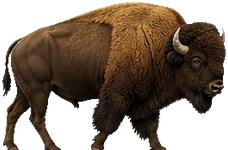
Yellowstone Bison
Yellowstone's bison are the only continuously wild, free-ranging descendants of the great plains herds. At roughly 5,000 animals in two herds, this is the largest bison population on public land in the United States.
Overview
American bison (Bison bison) are grazers — grasses and sedges make up most of their diet. Yellowstone's herd splits into a northern herd (Lamar Valley) and a central herd (Hayden Valley/Mary Mountain); they intermix in some winters but calve and rut separately.
Bison are the park's signature animal and also its most dangerous to visitors — they injure more people than any other species because they look slow but can run 35 mph and weigh up to a ton.
Where to find them
- Hayden Valley: Often the largest single herds in the park.
- Lamar Valley: Northern herd; easy roadside viewing.
- Madison & Firehole: Winter herds in the geyser basins.
- Anywhere green in summer: Bison cause 'jams' across the park.
When to look
Year-round. Calves ('red dogs') appear late April–May; the rut runs July–August (dramatic bellowing and sparring); winter herds gather in thermal valleys.
⚠️Stay at least 25 yd away
Frequently asked questions
How many bison are in Yellowstone?+
Roughly 5,000 in two herds at the summer peak — the largest free-roaming population on U.S. public land. Numbers fluctuate with the breeding cycle and a cooperative management program.
When are bison calves born?+
Late April through May. The orange-red calves ('red dogs') stand out against the herd and are a spring highlight. They darken to brown by late summer.
When is the bison rut?+
Late July through August. Bulls compete for cows, wallow in dust, and bellow dramatically. Prime viewing, but also when bison are most aggressive — keep distance.
Why are bison managed?+
Bison can carry brucellosis, which threatens cattle outside the park. NPS, the state of Montana, and tribes coordinate a management program including capture, transfer to tribes, and limited hunting outside park boundaries — keeping the herd healthy while addressing the disease concern.
Data & field guide
1,307 aggregate reports. Peak: Apr. Sighting frequency, not population abundance.
2,407 timed records. Daylight viewing bias applies.
Field identification: tracks & sign
Bison bison · Bovidae
Tracks
- Front foot
- 100–140mm × 90–130mm
- Hind foot
- 90–120mm × 80–110mm
- Track width
- 9–13cm
- Toes
- 2 (cloven hoof)
- Stride
- 50–70 (walk)cm
No external claws on main toes. Dew claws may show in deep substrate.
Scat & other sign
Round, flattened 'patties' (like cow pies) when fresh and soft. When dry, forms discrete round patties 15–25cm diameter. In winter (dry forage), may form discrete fibrous pellets.
Diameter: 150–250 (patty form)mm
Key identification features
- Large rounded cloven hoof tracks
- Cow-pie style scat patties
- Deep herd trails
- Wallows and rubbing posts with hair
- Herd-size groups of overlapping tracks
ℹ️In the field
annual
Wolf kills reveal elk and bison interaction cues
When a visible kill is present, watch the wider scene for wolf returns, ravens, coyotes, and grizzlies from the road.
NPS detected 211 wolf kills in 2024, including 126 elk and 47 bison.
Do not approach carcasses or leave roads to inspect kill sites.
spring-winter
Bison movement tracks forage, snow, and green-up
In spring, look for herds on fresh green-up; in winter, look for wind-scoured, lower-snow, or geothermal-influenced openings.
Bison are visible year-round, but snow depth and forage phenology explain where herds concentrate.
Keep at least 25 yards and never walk through a herd.
Dec-Mar
Habitat cue
Wind-scoured grass, lower-snow meadows, packed trails, and geothermal openings
Deep snow and forage access shape winter bison distribution.
Keep at least 25 yards and do not use bison trails as approach routes.
Apr-Jun
Habitat cue
Fresh green-up and repeatedly grazed meadows
Bison grazing can make areas green up earlier, faster, and for longer, helping explain spring herd concentration.
Do not enter herds or block animal movement.
May-Aug
Habitat cue
Orange calves in May; bellowing, wallowing, sparring, and tending in July-August
Seasonal behavior makes visible herds easier to interpret in Hayden, Lamar, Madison, and Firehole areas.
Bison injure visitors frequently; keep at least 25 yards.
Sources & data notes
- Seasonal and hourly patterns: aggregated from NPS and observer trip reports in the project dataset (1995–2026). Only monthly counts are published; no per-sighting location or observer data.
- Report signals: official NPS/USGS aggregate or narrative report facts only. Exact dens, raw sightings, and bear-jam points are not published.
- Track & sign field guide: compiled from NPS species references and field-identification literature.
- NPS Yellowstone Wolf Project Report 2024 — National Park Service (Values may be parsed or inferred from annual report text.)
- NPS Yellowstone bison ecology — National Park Service (Current official bison population/context page; not a granular survey dataset.)
Sources & data notes
- Bison data is drawn from official NPS, USGS, and NOAA sources catalogued in our source registry. Observer-submitted sightings are not published on this public guide.
- Bison carries dedicated official data (NPS ecology / management reports).
- NPS Yellowstone bison ecology — National Park Service (Current official bison population/context page; not a granular survey dataset.)
- NPS Yellowstone bison management — National Park Service (Official bison management goals and policy context; not individual observations.)
- Dryad bison population surveys in Yellowstone National Park 1970-1997 — Dryad / USGS / Montana State University (Historical aerial survey CSV metadata is public; direct file download may require browser/session access.)
Spotted something off, or want a deeper dive? Every claim above links to its original source — look for the ↗ markers and the Sources section.