How to See a Bear in Yellowstone
Seeing a bear in Yellowstone is not luck — it’s a method. Bears are where the food is, when the light is low, and visible where the ground is open. Get those three things right and your odds rise steeply. Here is the exact method experienced bear watchers use, built on official NPS bear management data.
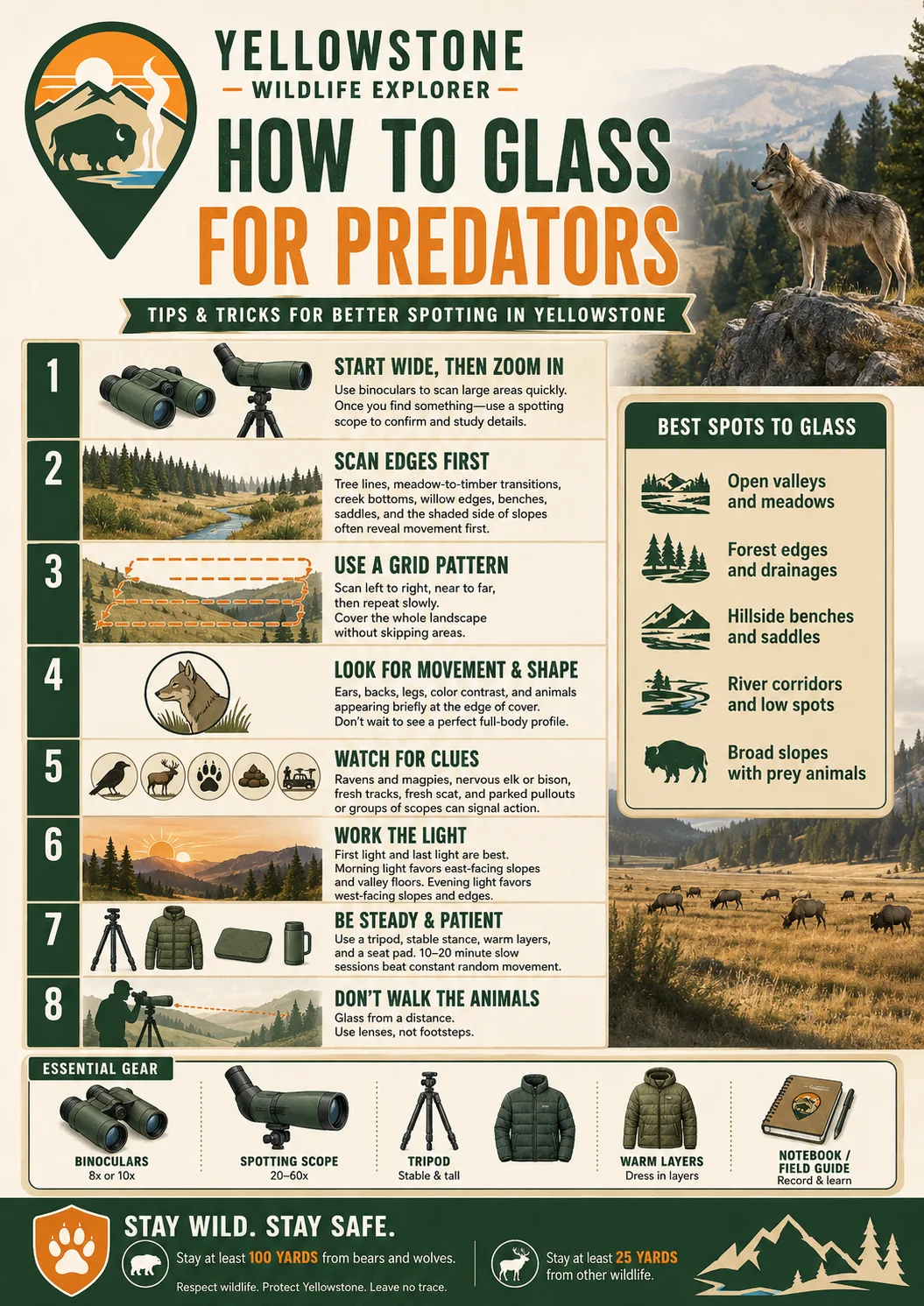
The method: seven steps that actually produce sightings
Step 1: Be there at dawn — and stay through the last hour of light
Bears are crepuscular: they feed most heavily in the first and last hours of daylight, then bed down in the trees through midday. That means your alarm clock matters more than your mileage. Be at your viewpoint before sunrise — in May that can mean a 5:00 a.m. start — and give the meadow at least an hour; bears frequently appear in the last fifteen minutes of a session. Sunrise and sunset shift by nearly a minute a day in spring, so check times for your exact dates rather than guessing.
✅Two sessions beat one long one
Step 2: Pick open ground, then glass it in strips
Bears show best against open ground: the big meadows of the Lamar Valley and Hayden Valley, the slopes below Dunraven Pass, the benches of the northern range. Once you’re there, don’t stare — scan. Sweep your binoculars across the meadow in overlapping left-to-right strips, front to back, then work back. You’re looking for movement and for shapes that don’t fit: a low dark form on a snowpatch, a sow trailing cubs across a bench. Bison and elk confusions resolve quickly with shape and gait — our predator spotting guide covers the tells in detail.
Step 3: Read the meadow like a bear would
A bear is almost always on its way to food. In spring, that means fresh diggings for roots and rodents on open slopes, and winter-killed carcasses near the treeline — if you find a carcass with ravens working it, glass carefully from a very long distance; bears defend carcasses. In early summer, follow the green-up line: the wave of new growth climbing uphill as snow melts, which bears track upslope through June and July. In late summer and fall, berry-producing slopes and pine stands draw bears back into view. Our where to see bears guide maps these habitats area by area.
Step 4: Use optics the way bear watchers do
Binoculars find bears; a spotting scope lets you actually watch them. Most bear watchers carry 8x or 10x binoculars as the working tool — unlike wolves, which are usually half a valley away, bears feed close enough that 10x resolves a grazing grizzly into fur, hump, and cubs. If you want to sit with a sighting — watching a sow nurse cubs or a boar dig for roots — a 20–60x scope on a tripod is the upgrade that makes it worthwhile. Our binoculars guide and spotting scope guide cover what the field actually demands.
Step 5: Work the rangers
The cheapest intel in the park is a five-minute conversation. Visitor center staff at Albright (Mammoth), Canyon, Grant, and Old Faithful track where bears have been seen over the last day or two, and bulletin boards list recent activity and closed areas. Rangers leading dawn walks in bear country will also teach you exactly how they glass. Ask one question: “Where have bears been seen lately?” — then go there for the next dawn session. Repeating a productive spot over consecutive mornings is how serious watchers fill a trip.
Step 6: Read a bear jam correctly — and never make one
A cluster of stopped cars is the park’s most reliable wildlife broadcast: something is out, and bear jams specifically mean a bear. Use them — but use them right. Pull completelyoff the pavement, stay in your vehicle, and move along promptly so others can stop. Never exit for a closer photo; a bear pushed off its food or separated from its cubs by a crowd is exactly how incidents happen. If you’re on foot, the rule is 100 yards (91 m) from bears and wolves — the length of a football field — and 25 yards from everything else. Our wildlife safety guide covers jam etiquette and distance rules in full.
⚠️Never sacrifice safety for the sighting
Step 7: Match your tactic to the season
The method stays the same; the ground moves with the food. Spring bears are confined to low, open country by lingering snow — the single most reliable season. Early summer pushes them upslope along the green-up line toward Dunraven Pass and Mount Washburn. Late summer is the hardest window as bears head into higher, brushier country. Fall hyperphagia brings long, visible feeding hours again. NPS bear management reports put the season’s start on the calendar — grizzlies emerge in early March:
| Year | First grizzly | Where |
|---|---|---|
| 2018 | March 10 | LeHardy Rapids |
| 2019 | March 8 | Mud Volcano |
For the full seasonal picture — including fall denning dates and the month-by-month breakdown — see our best time to see bears guide.
What your odds actually look like
Honest expectations: most visitors who spend two or three dawn sessions glassing the open valleys of the northern range in May, June, September, or October will see a bear. Most visitors who drive through once at midday in July will not. The difference is almost entirely method — timing (dawn), ground (open meadows), and optics — repeated across mornings rather than luck on any single one.
The population is on your side. The Greater Yellowstone Ecosystem supports hundreds of grizzlies — about 757at the 2014 interagency estimate, up from a few hundred at protection in 1975 — plus an unknown but healthy number of black bears, and they occupy essentially all of the park’s habitat. This is one of the only places south of Canada where both species still coexist in numbers. But bears are wild animals, not attractions: even a perfect method yields some blank mornings, and any sighting should be treated as a bonus, not a guarantee.
Distance rules and bear spray
Everything above happens at a distance, on purpose. Federal regulations require 100 yards (91 m) from bears and wolves and 25 yards (23 m) from all other wildlife — and regulation aside, bears behave most naturally, and photograph best, when they don’t know you’re there. If a bear changes its behavior because of you, you are too close: back away slowly, speak calmly, and give it more room. If you plan to hike at all — even a short valley trail — carry bear spray on a hip or chest holster and practice pulling it. Our bear spray guide walks through choosing, carrying, and using it.
Frequently asked questions
How likely am I to see a bear in Yellowstone?+
Better than most people expect — if you work for it. Bears live throughout the park, and visitors who spend several dawn or dusk sessions glassing the open valleys of the northern range usually see one within a few days. Visitors who drive through once at midday often don't. Repeated early mornings in bear habitat are what move the odds; there are no guarantees with wild animals.
What time of day are bears most active in Yellowstone?+
Dawn and dusk. Bears are crepuscular — most active in the first and last hours of daylight, especially in spring and fall. Midday, they typically bed down in timber. Plan a glassing session starting before sunrise and another in the hour before sunset.
Where should I look first thing in the morning?+
Start with open meadows: Lamar Valley and Hayden Valley are the classic grizzly morning spots, with Dunraven Pass and the slopes of Mount Washburn producing well in early summer. For black bears, work the forest edges around Tower-Roosevelt and the northern range. See our full guide to where to see bears in Yellowstone for area-by-area detail.
Do you need a spotting scope to see bears, or are binoculars enough?+
For bears, quality binoculars (8x or 10x magnification) are usually enough — bears feed closer to roads than wolves do, and you'll often spot them with the naked eye as a moving dark shape on a slope. A spotting scope earns its keep for watching behavior at a distance: sows with cubs, bears on carcasses, or digs high on a slide.
Do you need bear spray to see bears in Yellowstone?+
You should carry it. NPS strongly urges bear spray for all hikers, and it is required on some backcountry routes. For roadside and pullout viewing the risk is low, but any trail in the park crosses bear habitat. Carry it on your hip or chest strap — not inside your pack — and know how to remove the safety. See our bear spray guide.
Is it safe to stop at a bear jam?+
Yes, if you do it right. Pull completely off the pavement, stay in your vehicle, and keep moving along once you've had your look — do not stop in a lane or linger. Never exit for a closer photo. If you're on foot and see a bear, keep at least 100 yards (91 m) away: that's about a football field.
Can you see bears from the road in Yellowstone?+
Yes — and it is the highest-yield strategy. Most visitor bear sightings happen from or near the road, especially in the northern range: bears grazing valley meadows, crossing slopes, or feeding near the forest edge. Roadside glassing at dawn beats backcountry hiking both for odds and for safety.
What month is best for seeing bears?+
May–June and September–October. Spring puts bears in the open valley bottoms; fall hyperphagia keeps them feeding in view for long hours. July and August are the hardest months as bears follow the green-up into higher, brushier country. Our best time to see bears guide breaks down the seasons month by month.
Sources & data notes
- Grizzly population estimate and first-sighting dates: NPS Bear Management annual reports (2018, 2019) and the Interagency Grizzly Bear Study Team (IGBST) estimate cited therein.
- Activity patterns, viewing distances, and bear spray guidance: U.S. National Park Service Yellowstone bear safety guidance.
- Viewing tactics on this page are field-method guidance, not predictions; bear locations change daily.
- NPS Yellowstone Bear Management annual reports — National Park Service (Only a small subset of available annual bear reports is currently parsed.)
- NPS Yellowstone bear management page — National Park Service (Official bear-management process and BMA context; annual reports still need deeper PDF parsing.)
- NPS Yellowstone grizzly bear facts — National Park Service (Official grizzly facts from Yellowstone Science; species context only.)
- NPS Yellowstone Bear Management Area map links — National Park Service (Bear Management Area image-map links extracted from the NPS bear page; closure/safety context only.)
- NPS Yellowstone Bear Management Plan — National Park Service (Official management plan for bear-human conflict reduction and visitor safety; not sighting data.)
- NPS Bear Management Records archive finding aid — National Park Service (Archive finding aid for bear sightings, incidents, IGBST, and management records; not parsed as observations.)
- NPS first grizzly bear sighting of 2026 — National Park Service (Current official seasonal emergence signal; single event context, not a public viewing point.)
- NPS 2026 grizzly bear capture operations notice — National Park Service (Official seasonal capture-operation safety notice; closure/safety context only.)
- USGS occupied range of the Yellowstone grizzly bear 2008-2022 — U.S. Geological Survey (Range boundary derived from telemetry plus verified observations/sign; not individual locations.)
- USGS IGBST Yellowstone Grizzly Bear Investigations 2024 annual report — U.S. Geological Survey (Greater Yellowstone Ecosystem grizzly report; not limited to Yellowstone National Park.)