Where to See Bears in Yellowstone
Yellowstone is one of the only places south of Canada where grizzly and black bears still coexist in numbers. With the right timing, place, and safety gear, bear-watching here is extraordinary — and safe.
⚠️Carry bear spray — always
Two species, two habitats
Grizzly bears
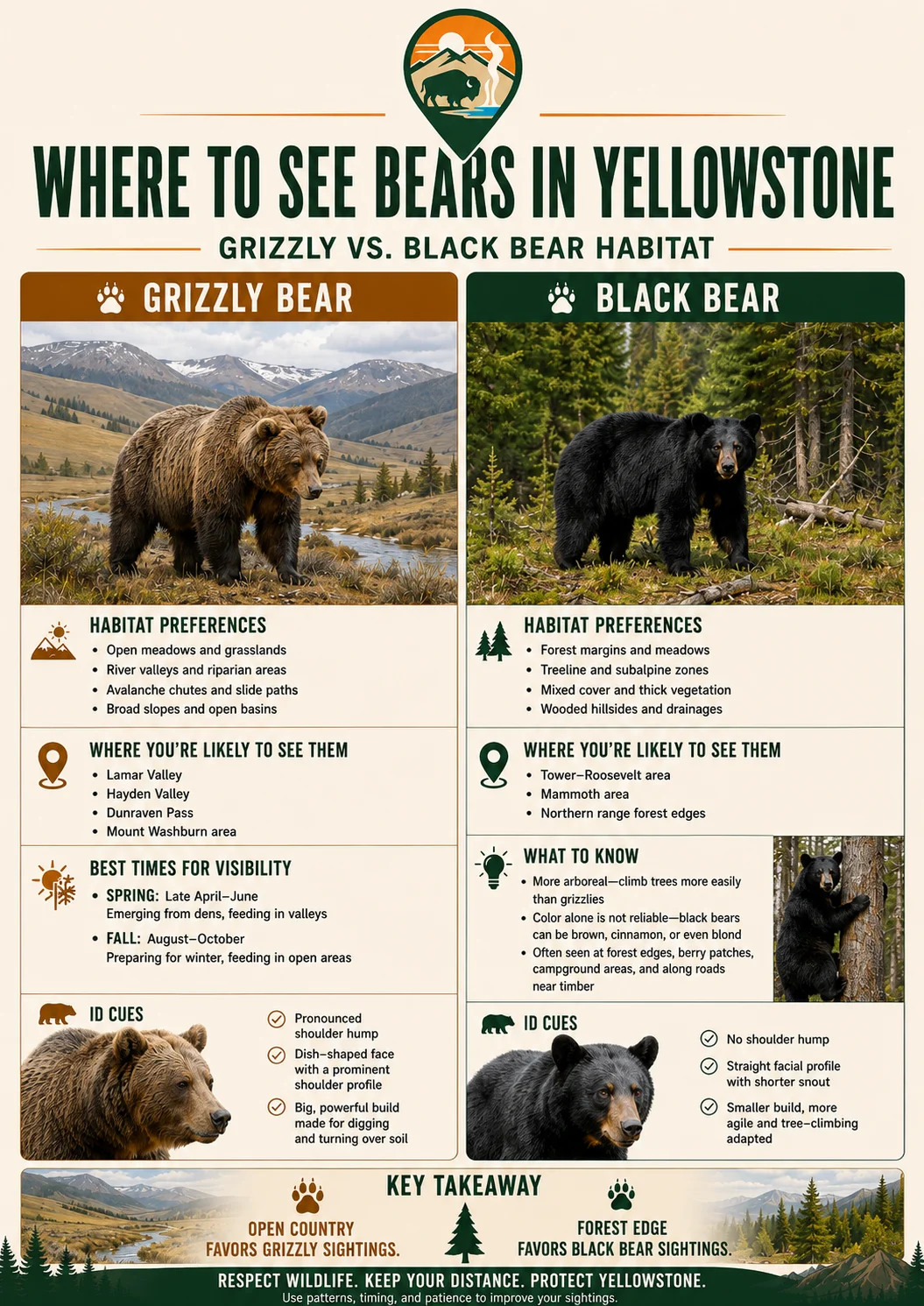
Grizzlies favor open terrain where they can dig for roots and rodents: the Lamar and Hayden valleys, the meadows around Dunraven Pass, and the high slopes of Mount Washburn. In spring they descend to lower elevations as snow recedes; by summer they follow the melting snowline upslope for new plant growth.
Black bears
Black bears prefer forest edges and are common around Tower-Roosevelt, the northern range, and Mammoth. Smaller and more arboreal than grizzlies, they’re often glimpsed at the treeline rather than in open valleys.
When bears emerge (NPS first-sighting data)
NPS bear management reports record the first confirmed bear sightings each year. The available data (deeply parsed for 2018 and 2019) shows grizzlies emerging in early March and black bears a few weeks later:
| Year | First grizzly | Location |
|---|---|---|
| 2018 | March 10 | LeHardy Rapids |
| 2019 | March 8 | Mud Volcano |
Official bear activity comparison
NPS annual totals provide context for how roadside bear activity changed between the two parsed report years. These are park-wide aggregates, not viewing targets.
Where to look, by area
- Lamar Valley — grizzlies in spring meadows (see Lamar Valley wildlife).
- Hayden Valley — grizzlies along the Yellowstone River (see Hayden Valley wildlife).
- Mount Washburn & Dunraven Pass — summer grizzlies following the green-up.
- Tower-Roosevelt area — black bears at the forest edge.
- Found the ground but not the bear? Work it with the field method in how to see a bear in Yellowstone.
Frequently asked questions
Where is the best place to see bears in Yellowstone?+
Grizzly bears are most often seen in the open meadows of the Lamar and Hayden valleys, around Dunraven Pass, and on the slopes of Mount Washburn in spring. Black bears are common in the forested edges of the northern range and around Tower-Roosevelt. Both are best spotted at dawn and dusk.
When do bears come out in Yellowstone?+
Grizzly bears typically emerge from dens in early spring — the first confirmed grizzly sighting in 2018 was on March 10 at LeHardy Rapids. Black bears emerge a few weeks later. Both are active through fall, when they feed intensively before denning.
How can I tell a grizzly from a black bear?+
Look for the grizzly's prominent shoulder hump (a muscle mass for digging), dish-shaped face, and large rounded ears set wide apart. Black bears have a straighter facial profile, no shoulder hump, and taller pointed ears. Color is unreliable — black bears can be brown, cinnamon, or even blonde.
How close can I get to a bear?+
You must stay at least 100 yards (91 m) from bears. Never get between a mother and cubs. If you surprise a bear at close range, back away slowly and speak calmly — and always carry bear spray where it's reachable.
Is bear spray required in Yellowstone?+
All hikers are strongly urged to carry bear spray, and it's required in some backcountry situations. It is the single most effective defense against a charging bear when used correctly. See our bear spray guide for how to choose and carry it.
Sources & data notes
- Bear sightings, jam counts, and first-sighting dates: NPS Bear Management annual reports (2018, 2019). These are the only years for which NPS annual reports are publicly available in parsed form.
- Grizzly population estimate: Interagency Grizzly Bear Study Team (IGBST), cited within the NPS 2018 report.
- Distance regulations and safety: U.S. National Park Service Yellowstone bear safety guidance.
- NPS Yellowstone Bear Management annual reports — National Park Service (Only a small subset of available annual bear reports is currently parsed.)
- NPS Yellowstone bear management page — National Park Service (Official bear-management process and BMA context; annual reports still need deeper PDF parsing.)
- NPS Yellowstone grizzly bear facts — National Park Service (Official grizzly facts from Yellowstone Science; species context only.)
- NPS Yellowstone Bear Management Area map links — National Park Service (Bear Management Area image-map links extracted from the NPS bear page; closure/safety context only.)
- NPS Yellowstone Bear Management Plan — National Park Service (Official management plan for bear-human conflict reduction and visitor safety; not sighting data.)
- NPS Bear Management Records archive finding aid — National Park Service (Archive finding aid for bear sightings, incidents, IGBST, and management records; not parsed as observations.)
- NPS first grizzly bear sighting of 2026 — National Park Service (Current official seasonal emergence signal; single event context, not a public viewing point.)
- NPS 2026 grizzly bear capture operations notice — National Park Service (Official seasonal capture-operation safety notice; closure/safety context only.)
- USGS occupied range of the Yellowstone grizzly bear 2008-2022 — U.S. Geological Survey (Range boundary derived from telemetry plus verified observations/sign; not individual locations.)
- USGS IGBST Yellowstone Grizzly Bear Investigations 2024 annual report — U.S. Geological Survey (Greater Yellowstone Ecosystem grizzly report; not limited to Yellowstone National Park.)