Yellowstone Badger
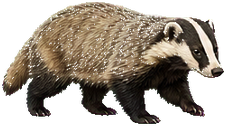
The badger is Yellowstone's low-slung sage-flat digger — a black-and-white-faced mustelid that excavates ground-squirrels with astonishing speed.
Overview
American badgers (Taxidea taxus) are stocky, powerful diggers built for excavating burrowing prey. They're common in the park's sage flats but low-profile — best on summer evenings when they emerge to dig.
Look for the low-slung body, black-and-white face stripe, and the telltale fresh dirt mounds of an active dig.
Where to find them
- Lamar Valley sage: Summer-evening digging.
- Hayden Valley sage: Open flats.
- Blacktail Plateau: Sage and grass.
When to look
Summer evenings (dusk) are best. They're less active in midday heat.
⚠️Stay at least 25 yd away
Frequently asked questions
What do badgers eat?+
Mostly burrowing prey — ground squirrels, pocket gophers, marmots — which they dig out with powerful claws. They can excavate a burrowing animal astonishingly fast.
Are badgers related to wolverines?+
Both are mustelids (the weasel family), but they're quite different. Badgers are short-legged diggers of open country; wolverines are large, wide-ranging scavenger-predators of remote wilderness.
Data & field guide
112 aggregate reports. Peak: May. Sighting frequency, not population abundance.
233 timed records. Daylight viewing bias applies.
Field identification: tracks & sign
Taxidea taxus · Mustelidae
Tracks
- Front foot
- 45–60mm × 45–60mm
- Hind foot
- 50–70mm × 35–50mm
- Track width
- 4.5–6cm
- Toes
- 5
- Stride
- 20–35cm
Extremely long claws on front feet (especially outer toes). Front claws 30–50mm. These are the most prominent feature of badger tracks.
Scat & other sign
Segmented, twisted, dark. Contains hair, bone fragments, and insect parts (especially ground squirrel remains). Deposited in burrows and near digging sites.
Diameter: 15–20mm
Key identification features
- 5-toed track with enormous front claws
- Pigeon-toed, wide stance
- Belly drag in snow
- Extensive digging near ground squirrel colonies
- D-shaped burrow entrances
ℹ️In the field
Sources & data notes
- Seasonal and hourly patterns: aggregated from NPS and observer trip reports in the project dataset (1995–2026). Only monthly counts are published; no per-sighting location or observer data.
- Report signals: official NPS/USGS aggregate or narrative report facts only. Exact dens, raw sightings, and bear-jam points are not published.
- Track & sign field guide: compiled from NPS species references and field-identification literature.
Sources & data notes
- Badger data is drawn from official NPS, USGS, and NOAA sources catalogued in our source registry. Observer-submitted sightings are not published on this public guide.
- Badger is documented via NPS reference pages; no dedicated population time-series is in the public dataset.
- NPS Yellowstone mammals overview — National Park Service (Official mammal checklist/context page with current park-level population notes; not point data.)
- NPS Yellowstone wildlife overview — National Park Service (Official wildlife viewing and habitat context; not observation records.)
Spotted something off, or want a deeper dive? Every claim above links to its original source — look for the ↗ markers and the Sources section.