Yellowstone Coyote
Coyotes are Yellowstone's smaller, scrappier canid — and a living case study in how bringing wolves back reshuffled an entire predator community.
Overview
Coyotes (Canis latrans) were the top canid in Yellowstone before wolf reintroduction, living in large loose packs. After 1995, wolves killed coyotes on sight and outcompeted them — coyote numbers fell, pack size shrank to mated pairs, and territories contracted. It's one of the clearest demonstrations of a top predator reshaping a mesopredator.
The coyotes that remain are still everywhere, hunting rodents in open meadows at dawn and dusk with the classic stiff-legged 'mousing pounce.'
Where to find them
- Lamar & Hayden valleys: Open meadow hunting.
- Mammoth & Gardiner: Year-round residents.
- Any open meadow, dawn/dusk: Scan for a trotting gray shape.
When to look
Dawn and dusk year-round. Winter can be excellent — their coats stand out against snow.
⚠️Stay at least 100 yd away
Frequently asked questions
How did wolves affect coyotes?+
Profoundly. After 1995, wolves killed coyotes and outcompeted them; coyote numbers dropped, packs shrank to pairs, and territories contracted. The survivors live under wolves by staying nimble.
How do I tell a coyote from a wolf?+
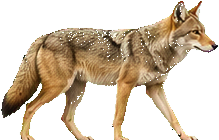
Size and build. A wolf is much larger with a broad head and blocky snout. A coyote is small and delicate — medium-dog-sized — with a narrow pointed snout, big ears, and a bushier tail carried low when running.
Do coyotes hunt in packs?+
Not usually in Yellowstone. They live in mated pairs (sometimes with a few offspring) and hunt alone or in pairs, mostly rodents. Wolves are the cooperative pack hunters.
Data & field guide
409 aggregate reports. Peak: Apr. Sighting frequency, not population abundance.
4,113 timed records. Daylight viewing bias applies.
Field identification: tracks & sign
Canis latrans · Canidae
Tracks
- Front foot
- 55–75mm × 50–70mm
- Hind foot
- 50–65mm × 45–60mm
- Track width
- 5–7cm
- Toes
- 4
- Stride
- 40–60 (trot)cm
Claws show in track (non-retractile). Small dots ahead of toe pads.
Scat & other sign
Rope-like, often twisted, tapered ends. Diameter 15–25mm. Frequently contains hair, bone fragments, berry seeds. Deposited on trails, roads, and prominent objects (scent-marking).
Diameter: 15–25mm
Key identification features
- Compact oval track (<75mm front)
- Direct-register trot in straight line
- Rope-like twisted scat on trails
- Three-lobed main pad
- Smaller and more pointed than wolf
ℹ️In the field
Sources & data notes
- Seasonal and hourly patterns: aggregated from NPS and observer trip reports in the project dataset (1995–2026). Only monthly counts are published; no per-sighting location or observer data.
- Report signals: official NPS/USGS aggregate or narrative report facts only. Exact dens, raw sightings, and bear-jam points are not published.
- Track & sign field guide: compiled from NPS species references and field-identification literature.
Sources & data notes
- Coyote data is drawn from official NPS, USGS, and NOAA sources catalogued in our source registry. Observer-submitted sightings are not published on this public guide.
- Coyote is documented via NPS reference pages; no dedicated population time-series is in the public dataset.
- NPS Yellowstone mammals overview — National Park Service (Official mammal checklist/context page with current park-level population notes; not point data.)
- NPS Yellowstone wildlife overview — National Park Service (Official wildlife viewing and habitat context; not observation records.)
Spotted something off, or want a deeper dive? Every claim above links to its original source — look for the ↗ markers and the Sources section.