Yellowstone Lynx
The Canada lynx is Yellowstone's rarest cat — federally threatened, effectively never seen, and confirmed only a handful of times in decades of monitoring.
Overview
Canada lynx (Lynx canadensis) are specialized snow cats — huge paws act like snowshoes, and they depend on snowshoe hares. They live in subalpine conifer forest and are extraordinarily secretive.
Yellowstone sits at the southern edge of their range. Confirmed detections (camera traps, tracks, hair snares) number in the single digits over decades. A visual sighting by a visitor would be exceptional and should be reported.
Where to find them
- Subalpine conifer forest: Deep snow, snowshoe-hare habitat — remote.
When to look
Dawn, dusk, and night, winter — but realistically, you will not see a lynx in Yellowstone.
⚠️Stay at least 25 yd away
Frequently asked questions
Are there lynx in Yellowstone?+
Yes, but barely — a tiny, threatened population at the southern edge of their range. Confirmed detections (via cameras, tracks, and genetics) number in the single digits over decades.
How is a lynx different from a bobcat?+
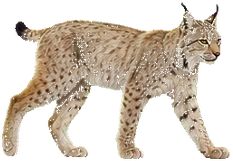
Lynx are larger with huge snowshoe-like paws, longer ear tufts, and a completely black-tipped tail. Bobcats are smaller with smaller paws and a white underside to the tail. Most 'lynx' sightings are bobcats.
What should I do if I see a lynx?+
Observe from distance, note the location and time, and report it to a ranger. Confirmed lynx records are scientifically valuable and contribute to monitoring the threatened population.
Data & field guide
No seasonal sighting data catalogued for this species yet.
No reliable timed activity pattern has been catalogued for this species yet.
Field identification: tracks & sign
Lynx canadensis · Felidae
Tracks
- Front foot
- 45–65mm × 55–75mm
- Hind foot
- 45–65mm × 50–70mm
- Track width
- 5–7.5cm
- Toes
- 4
- Stride
- 30–50 (walk), 60–120 (bound)cm
Claws are RETRACTILE — do not show in track. Same as all cats.
Scat & other sign
Segmented, buried, or deposited at prominent sites. Contains snowshoe hare hair and bones. Similar to cougar scat but smaller.
Diameter: 15–22mm
Key identification features
- Cat track (4 toes, no claws) that appears oversized/fuzzy in snow
- Wide toe spread
- Floats on snow surface
- Habitat: deep snow, spruce-fir forest
- Snowshoe hare-focused diet
ℹ️In the field
Sources & data notes
- Seasonal and hourly patterns: aggregated from NPS and observer trip reports in the project dataset (1995–2026). Only monthly counts are published; no per-sighting location or observer data.
- Report signals: official NPS/USGS aggregate or narrative report facts only. Exact dens, raw sightings, and bear-jam points are not published.
- Track & sign field guide: compiled from NPS species references and field-identification literature.
Sources & data notes
- Lynx data is drawn from official NPS, USGS, and NOAA sources catalogued in our source registry. Observer-submitted sightings are not published on this public guide.
- Lynx is documented via NPS reference pages; no dedicated population time-series is in the public dataset.
- NPS Yellowstone mammals overview — National Park Service (Official mammal checklist/context page with current park-level population notes; not point data.)
- NPS Yellowstone wildlife overview — National Park Service (Official wildlife viewing and habitat context; not observation records.)
Spotted something off, or want a deeper dive? Every claim above links to its original source — look for the ↗ markers and the Sources section.