Yellowstone Mule Deer
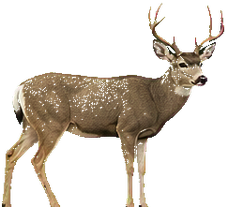
Mule deer are Yellowstone's common but lower-profile deer — smaller than elk, with enormous mule-like ears and a distinctive stiff-legged 'stotting' bounce.
Overview
Mule deer (Odocoileus hemionus) are widespread but less conspicuous than elk. They favor forest edges and browse more than they graze. The large ears and black-tipped tail distinguish them from the rarer white-tailed deer.
They're common around the northern range and Mammoth–Gardiner, often at the forest edge at dawn and dusk.
Where to find them
- Northern range: Forest edges, especially Mammoth to Gardiner.
- Mammoth fringes: Often near the developed zone.
When to look
Dawn and dusk, year-round. Fawns in late spring.
⚠️Stay at least 25 yd away
Frequently asked questions
How do I tell a mule deer from a white-tailed deer?+
Mule deer have oversized ears, a black-tipped tail, and bounce stiff-legged (stotting) when fleeing. White-tailed deer have a smaller build and raise a broad white flag-like tail when running. White-tails are much rarer in the park.
What is 'stotting'?+
The stiff-legged bouncing gait mule deer use to flee — all four hooves land together. It looks wasteful but lets them change direction instantly on broken ground.
Data & field guide
130 aggregate reports. Peak: Apr. Sighting frequency, not population abundance.
183 timed records. Daylight viewing bias applies.
Field identification: tracks & sign
Odocoileus hemionus · Cervidae
Tracks
- Front foot
- 50–70mm × 40–60mm
- Track width
- 4–6cm
- Toes
- 2 (cloven hoof)
- Stride
- 30–50 (walk), 100–200 (stot)cm
Dew claws may show at high speed or in deep snow.
Scat & other sign
Pellets, elongated with dimpled end. Similar to elk but smaller.
Key identification features
- Medium-sized pointed cloven track
- Small pellet scat with dimpled end
- Stotting bound gait (4 tracks together)
- Browsing at 0.5–1.5m height
ℹ️In the field
Sources & data notes
- Seasonal and hourly patterns: aggregated from NPS and observer trip reports in the project dataset (1995–2026). Only monthly counts are published; no per-sighting location or observer data.
- Report signals: official NPS/USGS aggregate or narrative report facts only. Exact dens, raw sightings, and bear-jam points are not published.
- Track & sign field guide: compiled from NPS species references and field-identification literature.
Sources & data notes
- Mule Deer data is drawn from official NPS, USGS, and NOAA sources catalogued in our source registry. Observer-submitted sightings are not published on this public guide.
- Mule Deer is documented via NPS reference pages; no dedicated population time-series is in the public dataset.
- NPS Yellowstone mammals overview — National Park Service (Official mammal checklist/context page with current park-level population notes; not point data.)
- NPS Yellowstone wildlife overview — National Park Service (Official wildlife viewing and habitat context; not observation records.)
Spotted something off, or want a deeper dive? Every claim above links to its original source — look for the ↗ markers and the Sources section.