Yellowstone Pronghorn
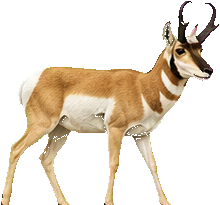
The pronghorn is North America's fastest land mammal — built for a treeless world of long sightlines and even longer chases against predators that no longer exist.
Overview
Pronghorn (Antilocapra americana) aren't true antelope — they're the last surviving member of a distinct North American family. They evolved their 60 mph speed to outrun the extinct American cheetah, which is why they're so much faster than anything that hunts them today.
In Yellowstone they live almost entirely on the northern range, in small numbers hemmed in by forest and barriers to migration.
Where to find them
- Lamar Valley sage: Open sagebrush flats along the valley floor.
- Mammoth to Gardiner: Northern-range sage, especially spring and fall.
- Blacktail Plateau: Open sage and grass.
When to look
Daytime, spring and fall when they gather on the lower northern range. Fawns (twins) are born May–June.
⚠️Stay at least 25 yd away
Frequently asked questions
Is a pronghorn an antelope?+
Not technically — it's the last surviving member of a distinct family (Antilocapridae) found only in North America. It looks like an antelope but isn't closely related to true African antelope.
How fast can a pronghorn run?+
Up to about 60 mph (97 km/h) — the second-fastest land mammal on Earth after the cheetah, and unlike the cheetah it can hold near-top speed for miles.
Where can I see pronghorn?+
Almost entirely on the northern range — Lamar Valley sage flats and the road from Mammoth to Gardiner. They prefer open, treeless country where they can see predators.
Data & field guide
210 aggregate reports. Peak: Apr. Sighting frequency, not population abundance.
777 timed records. Daylight viewing bias applies.
Field identification: tracks & sign
Antilocapra americana · Antilocapridae
Tracks
- Front foot
- 55–70mm × 45–60mm
- Track width
- 4.5–6cm
- Toes
- 2 (cloven hoof)
- Stride
- 35–50 (walk), 200–400 (sprint)cm
No external claws. Dew claws generally absent.
Scat & other sign
Pellets similar to deer but slightly smaller. Oval to round. Dark brown.
Key identification features
- Small pointed cloven tracks in open sagebrush
- Pellet scat (smaller than deer)
- Habitat: open grassland/sagebrush, not forest
ℹ️In the field
Sources & data notes
- Seasonal and hourly patterns: aggregated from NPS and observer trip reports in the project dataset (1995–2026). Only monthly counts are published; no per-sighting location or observer data.
- Report signals: official NPS/USGS aggregate or narrative report facts only. Exact dens, raw sightings, and bear-jam points are not published.
- Track & sign field guide: compiled from NPS species references and field-identification literature.
Sources & data notes
- Pronghorn data is drawn from official NPS, USGS, and NOAA sources catalogued in our source registry. Observer-submitted sightings are not published on this public guide.
- Pronghorn is documented via NPS reference pages; no dedicated population time-series is in the public dataset.
- NPS Yellowstone mammals overview — National Park Service (Official mammal checklist/context page with current park-level population notes; not point data.)
- NPS Yellowstone wildlife overview — National Park Service (Official wildlife viewing and habitat context; not observation records.)
Spotted something off, or want a deeper dive? Every claim above links to its original source — look for the ↗ markers and the Sources section.