Yellowstone Animal Tracks Guide
Tracks are useful clues, but they are not proof by themselves. Read size, shape, gait, substrate, and habitat together before deciding what passed through.
What to compare first
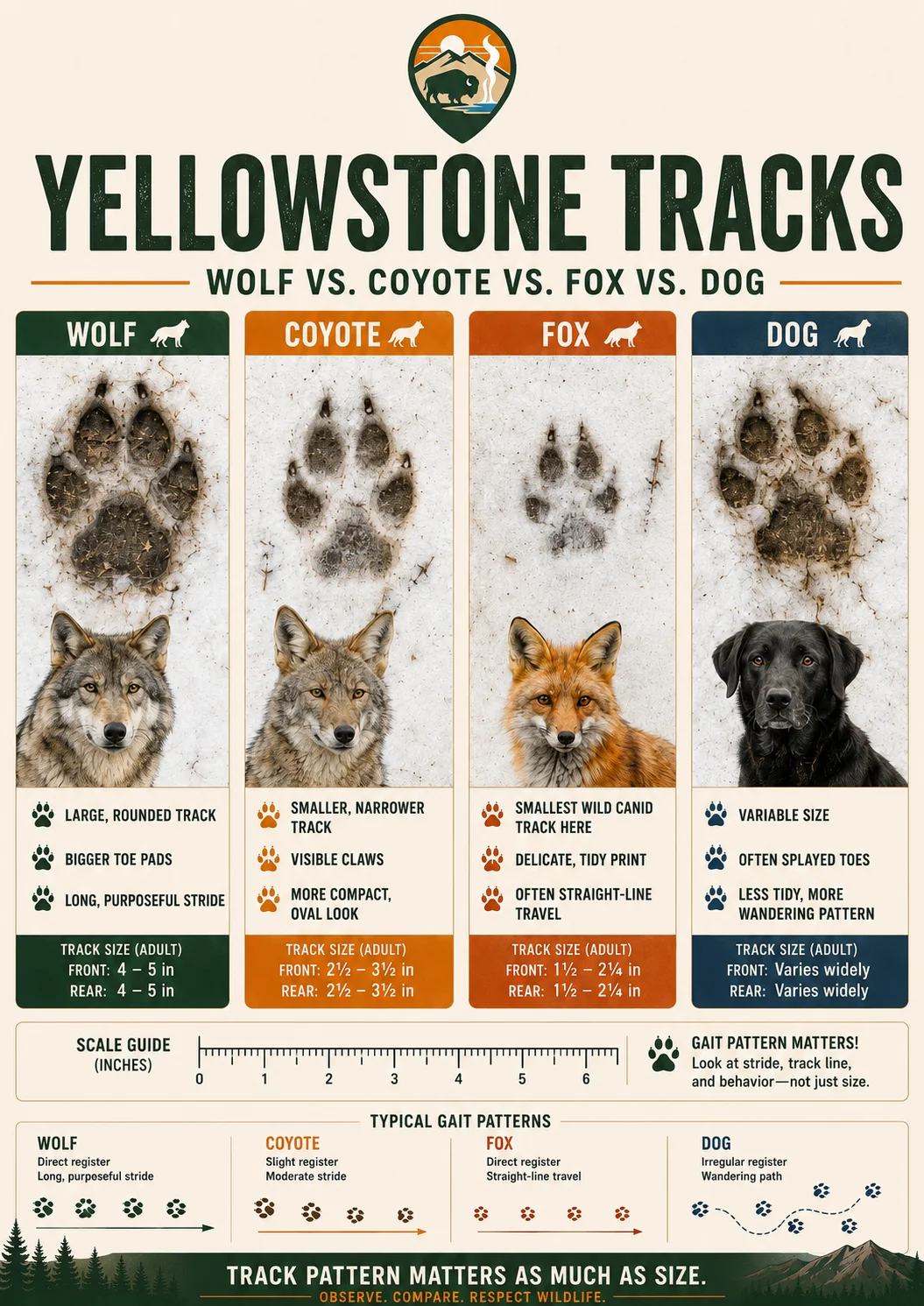
- Size: wolf tracks are substantially larger than coyote and fox tracks.
- Shape: wild canids often leave tighter, more oval prints than domestic dogs.
- Gait: wolves and coyotes tend to travel efficiently in direct lines.
- Context: a track near people, parking lots, or lodging may be a dog even if it looks wild.
ℹ️Use tracks to learn, not to close distance
Quick comparison: canids vs. common ungulates
These measurements are the front-track ranges compiled from field references. Use them as a starting point, not a verdict — substrate, gait, and overlap all distort a single print.
| Species | Front track length | Track width | Toes | Key field sign |
|---|---|---|---|---|
| WolfCanis lupus | 100–140 mm | 9–12 cm | 4 | Symmetrical track with 4 toes and claw marks |
| CoyoteCanis latrans | 55–75 mm | 5–7 cm | 4 | Compact, symmetrical oval track with 4 toes |
| Red FoxVulpes vulpes | 35–50 mm | 3–5 cm | 4 | Small, narrow, chevron-shaped track |
| Mule DeerOdocoileus hemionus | 50–70 mm | 4–6 cm | 2 (cloven hoof) | Cloven hoof, pointed at front |
| BisonBison bison | 100–140 mm | 9–13 cm | 2 (cloven hoof) | Cloven hoof (two toes), each crescent-shaped |
Note: wolf and bison front tracks overlap in length, but bison show a cloven-hoof shape (two toes, no claw marks) versus a canid's four toes with claw marks. That shape difference is more reliable than raw size.
Common mistakes
Snow can make tracks look larger as edges melt. Mud can flatten toe marks. Partial prints can hide claws. Take photos with a scale object only when you can do it from a safe, legal location.
For visual species ID beyond tracks, use the wildlife identification guide.
Sources & data notes
- Track measurements compiled from field-identification references (Halfpenny 1986; Elbroch 2003) catalogued in the project dataset. Ranges are typical front-track dimensions; actual prints vary with substrate, gait, and overlap.
- Use tracks to interpret behaviour and direction — not to pursue an animal. Yellowstone regulations require staying on established paths and viewing areas.
Frequently asked questions
How can I tell a wolf track from a coyote track?+
Wolf tracks are much larger and usually show a more direct travel line. Coyote tracks are smaller, narrower, and lighter. In Yellowstone, location and gait matter as much as a single print.
Can I identify an animal from one track?+
Sometimes, but not reliably. Snow melt, mud, overlap, and partial prints distort size and shape. Look for several clean prints, the gait pattern, and nearby habitat clues.
Should I follow fresh predator tracks?+
No. Tracks are for interpretation, not pursuit. Following fresh bear, wolf, or mountain lion tracks can disturb wildlife and put you too close.